v0.4.0
checking
mcp native · local-first · v8 audited
Your agents
stop forgetting.
An operating system for AI agents.
The persistent layer your LLMs run on top of. Memory formation, not retrieval. Background consolidation while they sleep. Conflict supersession when your mind changes. A knowledge-graph filesystem your agent walks instead of searches.
wires itself into
Claude Code
Cursor
VS Code
Cline
Roo
Continue
Goose
Codex
any MCP client
01 / in one minute
A minute can hold an entire nightmare.
An entire conversation lost to a context-window reset. Every fix, every preference, every name, every path you mentioned three weeks ago — gone in the time it takes to refill a coffee.
Mazemaker fixes that. Plug it in, and your agent gets a brain that…
Remembers what you tell it.
Preferences, decisions, fixes, the path of that file you mentioned three weeks ago. Formation at write time, not a search box bolted on at read time.
Connects related ideas.
Every memory is a node, every relationship a weighted edge discovered at insert. Like a notebook with cross-references, walked instead of queried.
Reflects while you sleep.
Overnight it strengthens what fired together, bridges nodes that never met, and crystallises clusters into summary memories.
Updates itself when you change your mind.
Newer contradictory facts supersede the stale ones instead of piling up beside them as noise.
The rest of this page goes deeper the further you scroll.
Don’t want to install anything? A managed endpoint runs at
api.mazemaker.dev — sign up,
point your agent at the MCP endpoint, done.
02 / the kernel
Not memory. The kernel.
Vector search retrieves nearby text. Mazemaker manages the cognition itself — and it maps, one for one, onto the thing it claims to be.
Kernel role
In an OS
In mazemaker
Processes
Scheduling work
Your agents. Each one gets its own memory space and its own recall surface.
Memory mgmt
Paging, eviction
Consolidation and supersession. Writes strengthen, decay or replace — never duplicate.
Filesystem
Files and inodes
The knowledge graph. Nodes and weighted edges, walked by spreading activation with attenuation.
Scheduler
Timers, cron
Dream cycles — 600s idle, 50 new memories, manual, or a standalone daemon.
IPC
Sockets, pipes
Federation. Pod-to-pod propagation over per-pair bearer keys and a public-prefix gate.
Syscalls
The ABI
Six MCP tools on loopback:
remember recall think graph dream dream_stats.
The difference is not a percentage. It is a phase change.
Questions a cosine search cannot answer by construction become routine. Not because the embeddings got better — because the memory has structure to walk.
CapabilitySearchMaze
Find a fact you told it onceYESYES
Follow A → B → C reasoning chainsNOYES
Notice related facts should connectNOYES
Replace stale facts when your mind changesNOYES
Explain why recall happenedNOYES
Get sharper while idle, not noisierNOYES
Your agent walks; it does not search.
Vector databases treat memory as a flat sphere of disconnected documents. Mazemaker builds a labyrinth: every memory a node, every relationship a weighted edge discovered at insert time. Spreading activation propagates outward with attenuation, the way human associative recall works. Hop-2 reasoning goes from R@10 0.00 to 1.00.
Consolidation nobody else runs.
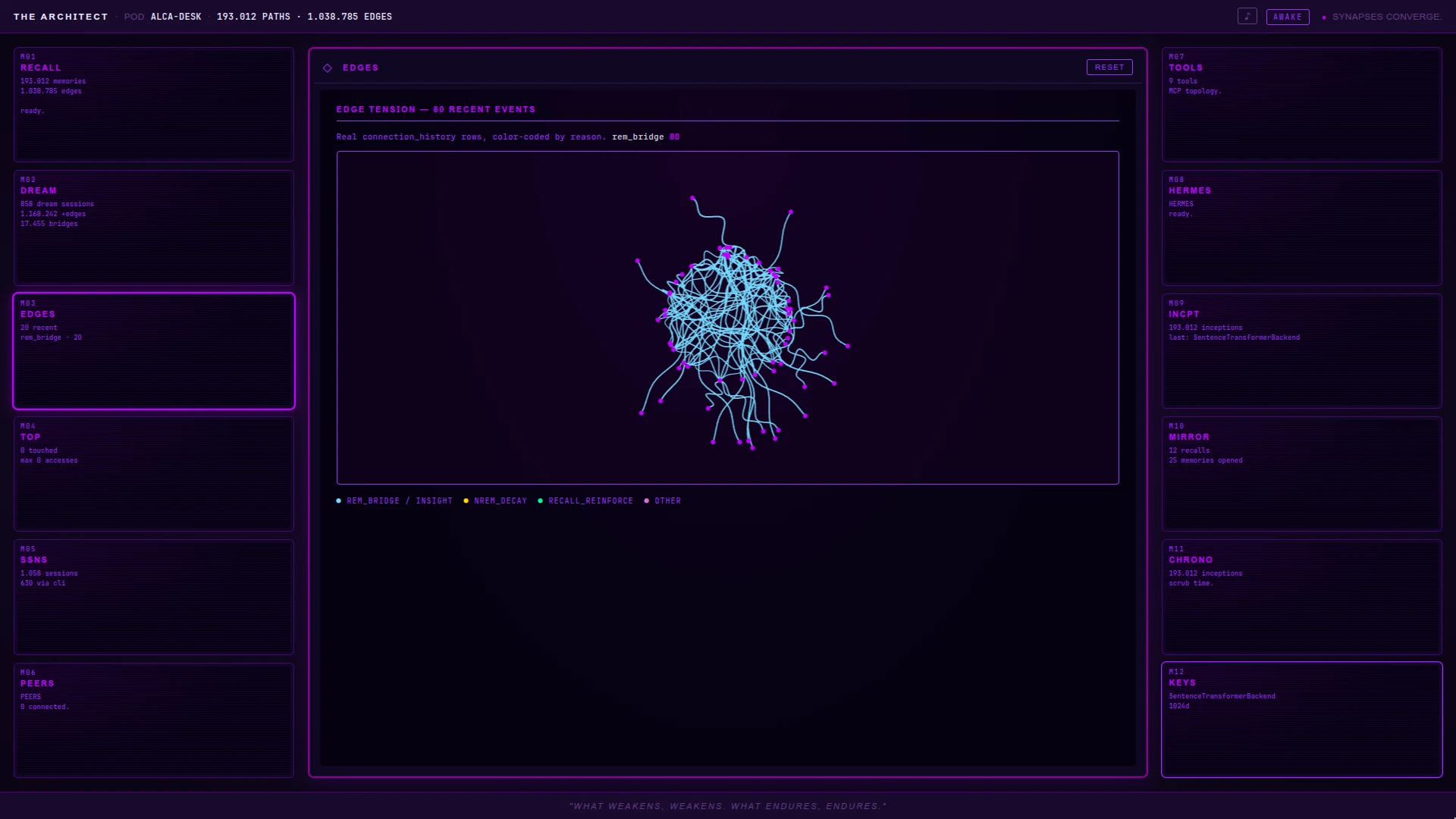
Three phases overnight: NREM replays and strengthens the edges that fired together, REM bridges isolated nodes that never met, Insight crystallises communities into summary memories. Post-dream synthesis on facts unreachable from any single memory: structurally 0.00 → 0.43 R@10.
The graph is queryable, not just searchable.
Every recall returns the activation trace — the path walked, the edge weights followed, the confidence at each hop. Your agent can debug its own retrieval; you can see why a memory surfaced instead of trusting a black box. The rest of the field stops at “here are the top-k documents”.
Eight rounds. Two rejections. One unconditional yes.
We submitted the whole suite — including the negative controls that must fail when their mechanism is removed — to GPT-5.5 via the codex CLI. The first two rounds rejected it outright. By round eight every concrete objection was closed by code change, not by argument. Every prompt and verdict is committed verbatim.
03 / the proof
Negative controls. Not benchmarks.
Every row below is a knob we turn off that must collapse the result. If the number doesn’t drop on demand when the mechanism is removed, the lift was a coincidence. Most AI infra ships positive demos; we ship the controls that have to fail.
“If you can’t make the number drop on demand, you don’t have evidence — you have a coincidence.”
Mazemaker testing protocol
Hop-2 graph reasoningAnswer reachable only through A → B → C edges. Vanilla cosine cannot solve it by construction.
0.00
1.00
Shuffled-edge controlEdges randomised: 1.00 collapses to 0.27. Traversal is load-bearing, not the embedding model accidentally helping.
1.00
0.27
Post-dream synthesisFacts inferable only after consolidation become reachable once dream cycles have run.
0.00
0.43
Conflict supersessionNewer contradictory facts supersede stale ones instead of duplicating noise.
0.03
0.33
Cross-session continuityConcept-mode distractors pile up; the graph still holds continuity across sessions.
0.06
0.62
Lean retrieval vs skynetReal prose, n=200: lean beats skynet by +0.18 R@5 and drops the dead-weight channels.
0.42
0.60
Elsewhere: R@5 = 0.9787 on LongMemEval-S (500q), 188/200 (94.0%, zero errors) on the Comparison Bench against Hindsight’s failed-models list, and 48.7 / 51.5 on EverMemBench run in their harness (gpt-4.1-mini / deepseek-v4-flash) against EverMemOS’s 44.6. Methodology and raw numbers →
04 / the scheduler
Dream Engine. It sleeps on it.
Three phases, run in the background on the pod. No competing product runs autonomous consolidation — which is why post-dream synthesis is a negative control and not a marketing line.
600s idle
50 new memories
manual via tooling
standalone daemon
Replay
Replays 100 recent memories through spreading activation, strengthens active edges by +0.05, weakens inactive ones, prunes anything under 0.05.
Bridge
Finds 50 isolated memories, searches for similar unconnected nodes, and creates bridge connections at similarity × 0.3.
Crystallise
Detects connected components, identifies bridge nodes, and materialises dream insights plus derived cluster memories.
+0.05edge reinforcement
0.43R@10 post-dream synthesis
<0.05dead edges pruned
0.3×bridge weight on similarity
05 / the deep dives
Walk the maze.
Nine pages, each one reproducible. The numbers, the engine, the cockpit, the install flow, the four-domain topology, federation, the phone, the competition, the lab notes.
06 / spawning the pod
Install. One command.
The browser opens itself for email verification and captcha, comes back, builds your local
pod, registers itself with every AI tool you have. Under three minutes — no
sudo, no Docker, no API keys to copy-paste.
your terminal
curl -fsSL https://api.mazemaker.dev/install.sh | bash
The script handles fingerprint init, opens the onboard wizard, polls for the handoff, signs the install proof, requests your license JWT, builds and starts the four containers, health-checks the pod, and offers to wire mazemaker into every AI tool it detects.
terminal → browser
install.sh detects your hardware, generates a device fingerprint and an Ed25519 install keypair, then opens your default browser at the onboarding wizard with everything pre-filled.
browser onboard
Verify your email with a 6-digit code, pass a Cloudflare Turnstile captcha, pick your tier. The wizard parks the install handoff and sends you back to the terminal. No JWT to copy, no keys to paste.
pod up · tools wired
Signs the install proof locally, fetches the license JWT, builds four rootless Podman containers, starts the pod, health-checks http://127.0.0.1:8765/sse, and registers mazemaker with every AI tool it detects.
Using something it didn’t detect?
Point any MCP-speaking client at http://127.0.0.1:8765/sse. The integration
spec at
api.mazemaker.dev/integration.md
documents native SSE, the mcp-remote stdio bridge and the streamable-http
transport — readable by humans and agents alike, so your agent can self-wire.
any tool · idempotent
curl -fsSL https://api.mazemaker.dev/wire.sh | bash
Something broken?
debug.sh runs 36 systematic checks across DNS, license, runtime staging,
container images, Quadlet units, systemd state and the host-facing endpoint. It
pattern-matches every failure mode collected during real installs; with
--fix it repairs everything safe to repair.
diagnose · or auto-fix
curl -fsSL https://api.mazemaker.dev/debug.sh | bash curl -fsSL https://api.mazemaker.dev/debug.sh | bash -s -- --fix
07 / license claims
Operator-grade pricing.
Tiered the way you deploy: one machine, your fleet, your org, your perimeter. Community stays free forever for personal single-agent use, and founder rates lock in for life.
- Single agent · personal use
- Hybrid recall (R@5 = 0.96)
- 3-phase dream, lightweight
- SQLite + FastEmbed CPU
- CLI + MCP server
- One-line install, or build from source
- 1 agent · 100k memories
- Hybrid recall · 3-phase dream
- SQLite or Postgres backend
- Managed install · auto-update
- BYOK or local MLX embeddings
- Email support · cancel any time
Recommended for operators
Pro
Multi-agent ops · the Architect cockpit · the full brain
$49/month
founder rate $29 · locked forever
- Unlimited agents and memories
- ColBERT @ 1.5 late-interaction
- Full-fat dream + DAE + Stage S
- Architect UI — 3D graph cockpit
- Peer federation across machines
- Postgres + pgvector · backups
- Email + chat support
- Everything in Pro
- Shared memory mesh across the team
- RBAC + audit log
- SSO (Google Workspace / Okta)
- Seat add-ons available
- Priority email support
Enterprise
Talk to us
For environments where data cannot leave the perimeter: airgap deploy, offline license, BYOK-HSM, a self-hosted license server, cross-site federation, SIEM-friendly audit export, custom dream cadence, SLA and dedicated support. Defense, robotics, regulated AI, research.
Contact sales
Runtime
Community
Builder
Pro
Team
Agents
11unlimitedunlimited
Memories
local100kunlimitedunlimited
Backend
SQLiteSQLite / PGPG + pgvectorPG + pgvector
Hybrid recall
yesyesyesyes
ColBERT @ 1.5 rerank
——yesyes
Dream engine
3-phase3-phasefull-fat + DAEfull-fat + DAE
Stage S synthesis
——yesyes
Architect cockpit
——yesyes
Federation
——peerteam mesh
RBAC · audit log · SSO
———yes
Support
communityemailemail + chatpriority
All paid tiers ship the full engine; tier-gated features flip on and off via license claims at runtime — same binary, same code path. BYOK embeddings stay on your machine; we never see your provider keys. Memories you wrote stay accessible forever, even if you cancel.
08 / objections
Common questions.
The objections we hear most. Short answers; pointers to the long ones.
Is curl … | bash safe?
You don’t have to pipe.
curl -fsSL https://api.mazemaker.dev/install.sh -o install.sh downloads the
script; read it, then run it. It’s short, signed and reproducible — every
release ships a SHA-256 in the changelog. Both it and its debug.sh twin are
linked from the onboarding page.
What happens when my license expires offline?
Seven-day grace period. The pod keeps running, reading and writing — the license client just stops phoning home. After the window it refuses new writes until the next check-in. Memories you already wrote stay accessible forever. Detail on the architecture page.
Can I migrate between Community and Pro?
Yes — same engine, only the rerank and synthesis layers differ. Community uses
SQLite WAL, Pro uses Postgres + pgvector. mazemaker dump exports your
store, mazemaker restore imports it on the other side. No re-embedding, no
re-graph-build. Vendor lock-in is the failure mode we design against.
Do you ever see my data?
No — structurally, not by promise. The license backend records
that a tool was called, never what was stored. Content stays inside the pod, encrypted
at rest with a vault key derived from HKDF(JWT, hardware-fingerprint) at
runtime — the key never touches disk. See manifesto and
privacy.
What if Mazemaker disappears?
The engine is AGPLv3 + PolyForm-NC source-available on GitHub. If the SaaS goes dark, Community and Lite users keep running; Pro users lose the managed install and cockpit, but the pod works off the last-issued license until grace runs out. Anyone can fork. Architecture is the policy — including the exit policy.
What hardware do I actually need?
8 GB RAM, x86_64 or Apple Silicon, any modern CPU. GPU optional (CUDA or MLX accelerate
recall ~3×, never required). ~500 MB of disk for the pod images plus your store.
gemma3:270m hit 18/20 on the Comparison Bench — a
Raspberry Pi-class model. The engine is heavier than the model.
Why local-first instead of cloud-native?
Because memory is the most intimate data class a coding agent will ever touch — every preference, every fix, every name, every path. Centralising it is the obvious play for a surveillance business model, and we’re explicitly not that. The manifesto is the long version; the topology enforces the boundary.
Pro vs Community in one sentence?
Community is free forever — a one-line pod, SQLite + CPU, single agent. Pro is the same engine plus ColBERT @ 1.5 reranking (R@5 0.96 → 0.98), DAE-augmented consolidation, Stage S synthesis, the Architect cockpit, unlimited agents, and the Postgres + pgvector backend the 100-iteration loop ran on.
Build the maze.
Your agent finds the way.
Persistent memory, graph reasoning, autonomous consolidation and audited lift — on your machine, in three minutes.
one line · no sudo
curl -fsSL https://api.mazemaker.dev/install.sh | bash
09 / the family
Part of a family.
Mazemaker shares its license-as-a-service spine with sister apps — same threat model, same install pattern, different shape on top.
available now · this site
mazemaker.online
AI-agent memory engine: knowledge graph + spreading activation + dream consolidation. Audited eight times by GPT-5.5, negative controls and all.
github.com/itsXactlY/mazemaker →
sister · pulse
remainder.online
Pulse, the sister product. Same pod and license-revolver spine, different shape on top: mazemaker remembers, pulse acts on the rhythm of what was remembered.
remainder.online →